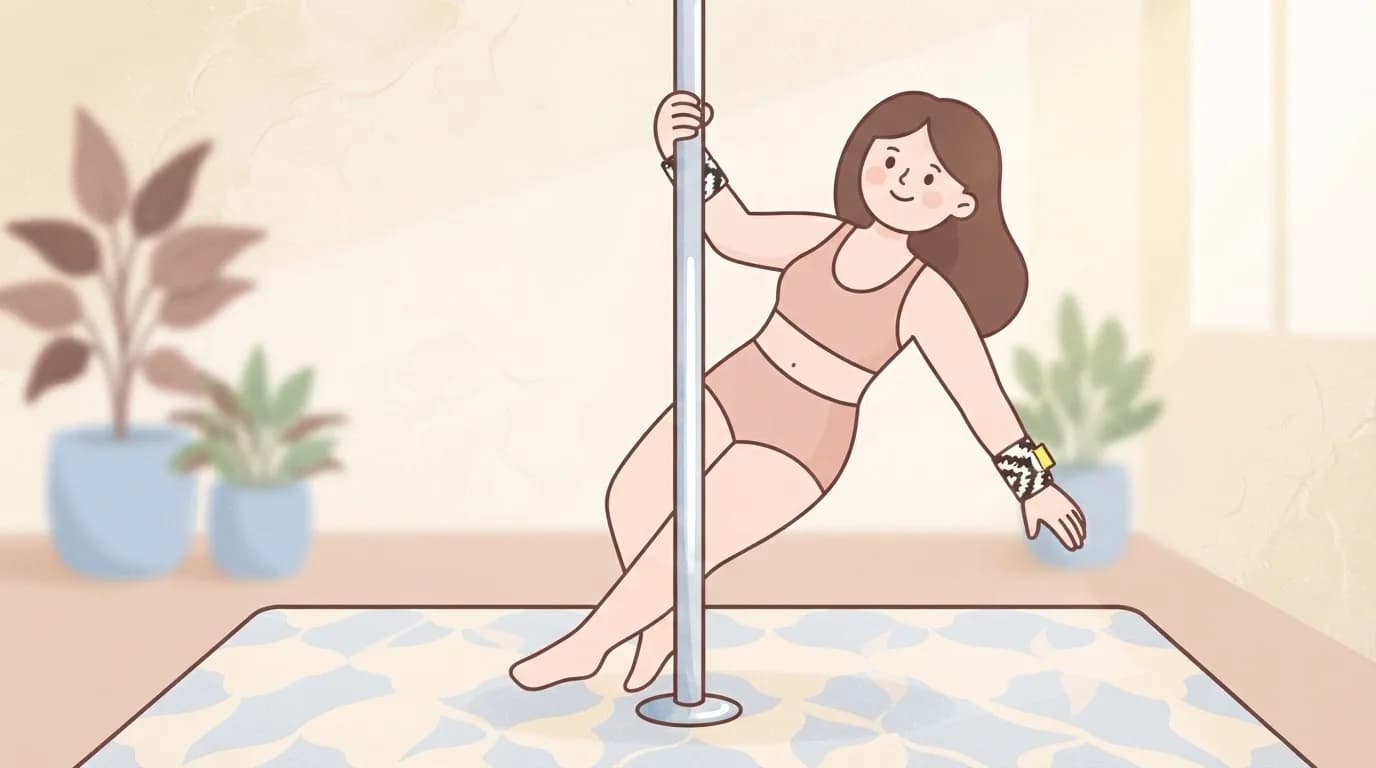
The short version
- Pole loads the wrist by gripping, by twisting in spins and handsprings, and by bending it back under your weight in floorwork, so pain can show up in different places.
- Cup grip keeps the wrist closer to neutral than twisted or split grip, which is why many teachers suggest it for dancers with sore wrists.
- Muscle soreness spreads across the forearm and fades in a few days, while injury pain is sharp, sits on one spot and gets worse with training.
- Tendons adapt more slowly than muscles, so add new grip work gradually and give your wrists rest days.
- See a doctor or physio for swelling after a fall, numbness or tingling, night pain, or pain that hasn't improved after about two weeks.
Pole dancing is hard on the wrists because you hang from your hands, twist around the pole and push your body weight through bent wrists, often all in the same class. Most pole wrist pain comes from doing too much new grip work too soon, on forearms that are cold or tired, and it usually settles with a proper warm-up, gradual conditioning, smarter grip choices and enough rest. Pain after a fall, swelling, numbness or pain that hasn't eased within two weeks needs a doctor or physio rather than more training.
I teach pole at Pandora Art of Pole in Slovenia, and I started SneakyDeez because my own wrists hurt, so this is the guide I wish I'd had as a student. It explains what each grip asks of your wrist, how to tell which kind of pain you have, and what you can do about it today.
Why does pole dancing hurt your wrists?
Your wrist is a small joint doing a big job on the pole. The muscles that close your hand sit in your forearm, and their tendons run across the wrist into your fingers, so every time you squeeze the pole those tendons are working under tension. Add your body weight hanging off that grip and you have a lot of load going through a joint the size of a matchbox.
Pole also asks the wrist to work in positions daily life never does. In a spin it's bent sideways while you hang, in a handspring it's rotated, and in floorwork or a handstand it's bent all the way back with your weight pressing down on it. None of that is dangerous in itself, but each position stresses a different part of the joint, which is why pole dancers can end up with pain in very different spots.
It isn't just you, either. In a large online survey of pole dancers, the wrist came second only to the shoulder as the most commonly injured area (Lee and colleagues, 2020), and a study of Polish pole dancers found that training volume and coming back too soon after an injury were linked to getting hurt again (Szopa and colleagues, 2022).
Which pole moves load the wrists most?
Almost every move uses your hands, but some ask a lot more of the wrist than others. This is a rough guide to what the wrist is doing in each family of moves and what to keep an eye on.
| Move or grip | What your wrist is doing | What to watch |
|---|---|---|
| Spins and basic holds | Hanging, bent towards the little finger, with a tight grip | Forearm fatigue and an ache on the pinky side if you death-grip |
| Handspring, twisted grip | Turned and bent hard towards the little finger, shoulder rotated inwards | Pinky-side wrist pain and shoulder strain when you're tired |
| Handspring, cup grip | Closer to neutral, the hand cups the pole with the thumb alongside the fingers | Needs a strong bicep pull, which takes time to build |
| Handspring, true or split grip | Top palm turned up, so the wrist and forearm twist under load | Forearm and wrist soreness if you rush the progression |
| Forearm grip | Pole pressed into the inner forearm, wrist held bent | Skin friction, bruising and a pinch on the thumb side |
| Shoulder mount, climbs and inverts | One hand pulls while the other pushes, with the wrist bent back | Pain on the back of the wrist from the pushing hand |
| Floorwork, handstands, push-ups | Bent fully back with your weight on it | A pinch on the top of the wrist when you lean forward |
Handsprings and the grip you choose
Handsprings are where a lot of wrist trouble starts, because you're upside down with most of your weight in your hands. Physios who work with pole dancers usually describe cup grip as the kindest of the three on the wrist, because the wrist stays closer to neutral, while twisted grip bends the wrist hard towards the little finger and asks a lot of the shoulder, and a true or split grip with the palm turned up puts more twist through the wrist and forearm (The Pole Physio). That doesn't make twisted grip wrong, and plenty of dancers use it happily, but if your wrist complains it's worth asking your teacher to help you try a cup grip. My guide to twisted grip vs cup grip for handsprings goes through how each one loads your wrist and shoulder.
Forearm grip and elbow grip
Forearm grip moves part of the load off your hand and into the forearm, which many people find kinder on the wrist, but it presses the pole into the soft inside of your arm, which is where a lot of pole kisses and bruises come from, and it holds the wrist bent. Elbow grip takes the hand out of the job almost entirely, which is why teachers often suggest it as an alternative while a sore wrist settles.
Shoulder mounts, inverts and floorwork
In a shoulder mount or a split-grip invert your bottom hand pushes into the pole with the wrist bent back, and on the floor every handstand, push-up and kneeling slide does the same. If the pain lives on the top of your wrist and only shows up when you lean over your hands, this is the most likely trigger. Our guides on wrist pain in handstands and wrist pain when the wrist is bent go into that position in more detail.
Where does it hurt? Common pain patterns in pole dancers
Where you feel it is a useful clue, although it's only a clue. A physio or doctor can tell you what's actually going on, and you should see one if anything in this table hangs around.
| Where you feel it | Often linked with | What tends to help |
|---|---|---|
| Thumb side of the wrist, worse when you grip or bend the thumb | Irritated thumb tendons, sometimes De Quervain's | Less forearm grip and squeezing for a while, thumb-friendly grips, see a physio if it lasts |
| Little-finger side, worse when you twist or lean on the hand | Overloaded soft tissue on the ulnar side, sometimes the TFCC | Fewer twisted-grip reps, avoid leaning on that hand, get it checked if it clicks or feels weak |
| Top of the wrist when it bends back under weight | Compression at the back of the joint | Elevating the heel of the hand, shorter holds, fists or parallettes for floor drills |
| Inner forearm or the inside of the elbow | Tired grip muscles, sometimes golfer's elbow | Grip rest days, gradual strength work, a gentler grip |
| A general ache across the forearms a day or two later | Normal muscle soreness | Easy movement and time |
If you want to read more about a particular spot, we have separate guides on thumb-side wrist pain and De Quervain's, pinky-side wrist pain and ulnar-side impaction. Cleveland Clinic has a clear explainer on TFCC tears, the cartilage on the pinky side that rotation under load can irritate, and Mayo Clinic covers golfer's elbow if the ache sits at the inside of your elbow.
Is it normal soreness or an injury?
Sore forearms after a grippy class are normal, especially in your first months. Muscle soreness usually arrives a day or two after training, spreads across the muscle rather than sitting in one point, and eases within a few days as you move around.
Injury pain behaves differently. It tends to start during the move, it's sharp or very specific, it sits on one spot of the joint, and it gets worse with training instead of better. Clicking with pain, a sudden loss of strength, or pain that wakes you up at night all belong in that second group.
A simple check I'd use is the next-morning test. If your wrist feels the same or better the morning after class, the load was probably fine. If it's stiffer or sorer than the day before, you did more than it was ready for and the next session should be lighter.
How do you stop your wrists hurting in pole?
There's no single trick, but a handful of habits make a big difference, and most of them cost nothing.
Warm up the wrists properly
A general warm-up gets your body moving, but your wrists and forearms need their own few minutes before you hang on them. Circles, gentle loading on the floor and a few easy grip holds on the pole are enough. Our 10-minute wrist warm-up for pole and aerial gives you the whole routine with timings, and if your studio is chilly, read how to warm up in a cold studio too.
Build strength slowly, because tendons are slower than muscles
Your muscles get stronger within weeks, but tendons and ligaments adapt over months (Mersmann and colleagues, 2017). That's why so many dancers feel strong enough for a new move before their wrists are ready for the repetitions. A short conditioning routine two or three times a week closes that gap, and our six-week wrist conditioning plan for pole lays it out week by week. If you have a pole at home, my 20-minute home pole conditioning session covers your core, shoulders, back and grip, and most of it doesn't even need the pole.
Spread the load in class
Drilling the same handspring on the same side fifteen times is the quickest way to an angry wrist. Alternate sides, mix grips where you can, take proper rests between attempts and stop drilling a move when your technique starts to slip, because tired arms grab harder and wrists take the hit.
Sort out your grip
When your hands slide, you squeeze harder, and squeezing harder loads the tendons over your wrist. Skip hand cream on pole days, keep the pole clean, and use a grip aid if your skin is dry or sweaty. Using your legs, your skin contact and your shoulders properly also means your hands don't have to do all the work.
Rest like it's part of training
Wrists need time to adapt between sessions, so a day off after a heavy grip class is training too. If you're adding classes, add one at a time and give it a couple of weeks before you add another. If you're new, our guide to your wrists in your first month of pole explains what to expect.

Masha's tip: I'd always rather you leave class with one more attempt in you than squeeze out a last handspring on a tired wrist. That last rep is usually the sloppy one, and it rarely teaches you anything new.
Do wrist wraps help with pole wrist pain?
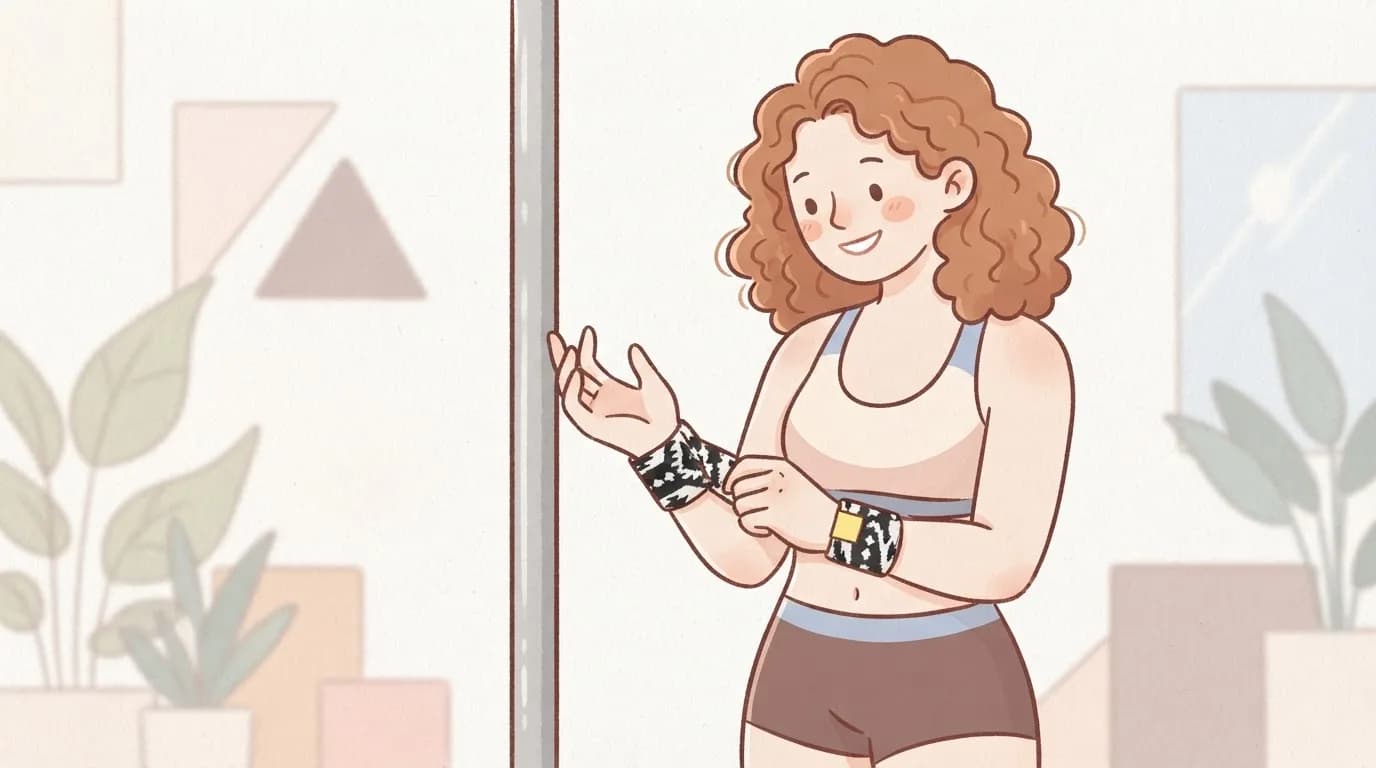
A good wrap can help you feel more supported while you train. Firm elastic compression around the joint gives a sense of stability, keeps the wrist warm, and acts as a gentle reminder to keep it in a strong line instead of collapsing into it. What a wrap can't do is replace warming up, building strength or getting a sore wrist checked, and it isn't a treatment for an injury.
For pole, the details matter. A wrap that sits on your palm or creeps up your forearm changes your skin contact with the pole, so I made ours to sit low on the wrist, right on the joint, and to support it without locking it stiff. If you're deciding on width, size or fabric, our guide to choosing and wearing wrist wraps for pole covers all of it, and how to measure your wrist size takes about a minute.

If you have a diagnosed condition or you're recovering from an injury, ask your physio whether a compression wrap suits you before you rely on one.
More on pole wrists, topic by topic
Some moves deserve a guide of their own because they push so much of your weight through a bent-back wrist. If your bottom hand hurts every time you go up, my guide to shoulder mount wrist pain goes through the set-up and the strength that take the load off it. Heels classes ask the same of your wrists on the floor, so I've also written about looking after your wrists and knees in exotic floorwork.
A mildly sore wrist doesn't have to mean a week away from the studio. As long as none of the warning signs below apply, there's usually plenty you can still work on, from leg holds to elbow grip and floor flexibility, and I've put it all together in what to train when you're pole dancing with a sore wrist.
Your grip and your kit make a quieter difference. Sweaty, dry and cold hands each slip for a different reason, and my comparison of pole grip aids helps you match one to your skin. A clean, dry pole matters just as much because it gives you the same surface every time, and my guide on how to clean a dance pole covers chrome, brass, stainless steel, powder-coated and silicone finishes. On chilly evenings, a waist warmer for pole and aerial keeps your lower back warm between turns while your arms and legs stay free.
If you fly as well as spin, the load on your wrists changes with the apparatus. Pole is usually the hardest of the three on the wrist joint itself, while silks are the hardest on grip and forearms, and my comparison of pole, aerial hoop and silks for your wrists explains how to prepare for each one.
When should you see a doctor or physio about wrist pain?
Most training aches settle with a lighter week, but some signs mean you should stop and get checked. The NHS advice on wrist pain is a good reference, and these are the ones I'd never train through:
- You fell or landed on your hand and the wrist is swollen, bruised or an odd shape.
- You heard a snap or pop, or you can't move or grip properly.
- You have numbness, tingling or pins and needles in your hand that doesn't go away.
- The pain wakes you at night or is there even at rest.
- It keeps coming back, or it hasn't improved after about two weeks of looking after it.
If you can, find a physio who knows pole or aerial, or at least gymnastics or climbing. They'll understand the positions you need to get back to, and they can give you a plan for staying on the pole in a modified way while things settle, which is usually better for both your wrist and your morale than stopping completely. If hoop or silks are your thing as well, our wrist care guide for aerial hoop and silks covers what changes in the air.
Everything in this guide
- Exotic Pole Floorwork in Heels: How to Look After Your Wrists and KneesKnee slides, body rolls, floor spins and splits in heels put a lot through your wrists and knees. This is how a pole teacher sets floorwork up so it stays kind to both.
- A 20-Minute Home Pole Conditioning Session (Most of It Needs No Pole)A timed 20-minute session for core, shoulders, back, glutes and grip that you can do at home without a pole, with wrist-friendly swaps for every move that loads the hands.
- How to Clean a Dance Pole: Chrome, Brass, Stainless, Powder-Coated and SiliconeA simple routine for cleaning any dance pole, which cleaner suits chrome, brass, stainless, powder-coated and silicone finishes, and why a clean pole grips better.
- Pole Kisses: Why Pole Dancing Bruises You and When a Bruise Needs CheckingWhy pole kisses happen, where they usually show up, how to look after them, and the bruising signs that mean you should see a doctor instead of blaming the pole.
- Can You Still Pole Dance With a Sore Wrist? What to Train While It SettlesA pole teacher's plan for the weeks your wrist needs a break: what to keep training, what to skip, when to get it checked and how to ease back in.
- Pole Grip Aids Compared: Which Type Suits Dry, Sweaty or Cold Hands?A pole teacher's no-brands comparison of grip aid types, which suits dry, sweaty or cold hands, how pole finish and studio rules change things, and why wraps go on first.
- Pole vs Aerial Hoop vs Silks: Which Is Hardest on Your Wrists?Pole, hoop and silks all ask a lot of your hands, but in different ways. This side-by-side guide shows where each one loads your wrists and how to get ready for whichever you love.
- Wrist Wraps for Pole Dancing: How to Choose, Size and Wear ThemWhere wraps should sit so your grip stays yours, which width and size to pick, how tight is right, and how to look after them, from a pole teacher who makes them.
- A 10-Minute Wrist Warm-Up for Pole and AerialTwelve simple steps in ten minutes get your wrists and forearms ready for spins, hangs and handstands, with timings and a note on how each part should feel.
- Pole Conditioning for Stronger Wrists: A 6-Week PlanA step-by-step wrist conditioning plan that takes fifteen minutes, two or three times a week, and prepares your wrists for handsprings, shoulder mounts and floorwork over six weeks.
- Wrist Care for Aerial Hoop and Silks: Grip, Hangs and ConditioningHoop and silks are mostly hanging and pulling, so your forearms and grip do long shifts. This guide shows you how to hold on smarter, build grip endurance and look after your wrists.
- Training in a Cold Studio: Warming Up Your Wrists and Lower BackCold hands grip worse and cold backs feel stiff, so this is how to warm up, layer and stay warm between turns when your pole or aerial studio never quite heats up.
- Shoulder Mount Wrist Pain: Why Your Bottom Hand Hurts and How to Fix ItThe bottom hand in a shoulder mount does a lot more work than anyone warns you about, so here's how to set it up, build it up and give it a break when it needs one.
- Twisted Grip vs Cup Grip: Which Handspring Grip Is Kinder to Your Wrists?Both handspring grips are valid, but they load your wrist and shoulder very differently, so here's how to work out which one your body is ready for.
- Waist Warmers for Dancers: Why Pole and Aerial People Keep Their Lower Back WarmWhy dancers and aerialists keep their lower back and core warm between turns and in cold studios, and how to wear, layer and size a waist warmer so it stays put all class.
Questions people ask
Is it normal for your wrists to hurt after pole dancing?
Tired, achy forearms a day or two after a grippy class are normal, especially when you're new. Sharp pain in one spot of the wrist, pain during a move, or pain that gets worse from class to class is not something to train through.
Which handspring grip is easiest on the wrists?
Cup grip usually keeps the wrist closest to neutral, so many teachers and physios suggest it for dancers whose wrists complain. Twisted grip bends the wrist hard towards the little finger, and split grip with the palm up twists the forearm more. Ask your teacher to check your setup before you switch.
Should I stop pole if my wrist hurts?
Not always. For a mild training ache, swap grip-heavy moves for ones that use your legs and elbow grip, cut down on handsprings and floorwork for a week or two, and keep moving. Stop and get it checked if there was a fall, swelling, numbness or pain that isn't improving.
Can wrist wraps stop wrist pain in pole?
Wraps give compression, warmth and a feeling of support, and many dancers train more comfortably in them. They don't treat an injury or replace warm-up, conditioning and rest, and if you have a diagnosed problem you should ask your physio first.
How long does pole wrist pain take to go away?
A simple overload ache often settles within a few days to two weeks if you lighten your training. If it hasn't improved after about two weeks, or it keeps coming back, see a doctor or physio.
Shop the fix
Wraps made for exactly this
Handmade in Slovenia by a pole teacher, with firm compression that sits low on the wrist.
Sources we checked
- NHS: Wrist pain
- Lee, Lin and Tan (2020): Prevalence of pole dance injuries from a global online survey
- Szopa et al. (2022): Factors associated with injury and re-injury in female pole dancers, Scientific Reports
- Cleveland Clinic: TFCC tear
- Mersmann et al. (2017): Imbalances in the development of muscle and tendon
Written by
Masha Pinner
Pole dance teacher at Pandora Art of Pole in Slovenia and former fashion designer. Masha started SneakyDeez in 2017 after years of teaching on sore wrists, and she still designs every pair.
Read Masha’s story